 For Client Support:


 Blog Details


Houston cloud consulting helps local businesses choose, migrate, secure, and manage cloud technology based on real operational goals. A consultant should not begin by selling the most complex architecture. The work should begin with the business problem: unreliable hosting, scattered files, remote access, slow applications, weak backups, rising costs, or systems that cannot support growth.
Houston has a wide mix of energy, healthcare, construction, logistics, professional services, retail, and small-business organizations. These companies may use very different software, but they share a need for secure access, dependable systems, clear recovery plans, and technology that can scale without unnecessary overhead.
What a Cloud Consultant Actually Does
A cloud consultant translates business requirements into a technical roadmap. That may include selecting a platform, designing infrastructure, preparing data, estimating costs, planning security controls, coordinating a migration, and helping the team operate the new environment after launch.
- Assess websites, applications, databases, file storage, backups, and current hosting.
- Compare AWS, Microsoft Azure, Google Cloud, IBM Cloud, managed hosting, and hybrid options.
- Identify quick wins and systems that should not move yet.
- Design identity, access, networking, monitoring, backup, and recovery controls.
- Create a migration sequence with testing and rollback steps.
- Review monthly cloud spending and remove waste.
- Document the environment so the business is not dependent on one person.
Common Reasons Houston Businesses Move to the Cloud
Growth has outpaced the current hosting
A website or application that worked for a small customer base may become slow or unstable as traffic, transactions, and data increase. Cloud architecture can add capacity, caching, monitoring, and more reliable deployment processes.
Teams need secure access from multiple locations
Cloud systems can make approved data and applications available to employees in offices, homes, job sites, and customer locations. Access should still be controlled with strong identity, least privilege, and multi-factor authentication.
Backups exist but recovery has not been tested
A backup is useful only when it can be restored. Cloud consulting should include recovery objectives, protected copies, documented procedures, and periodic testing.
Technology costs are difficult to explain
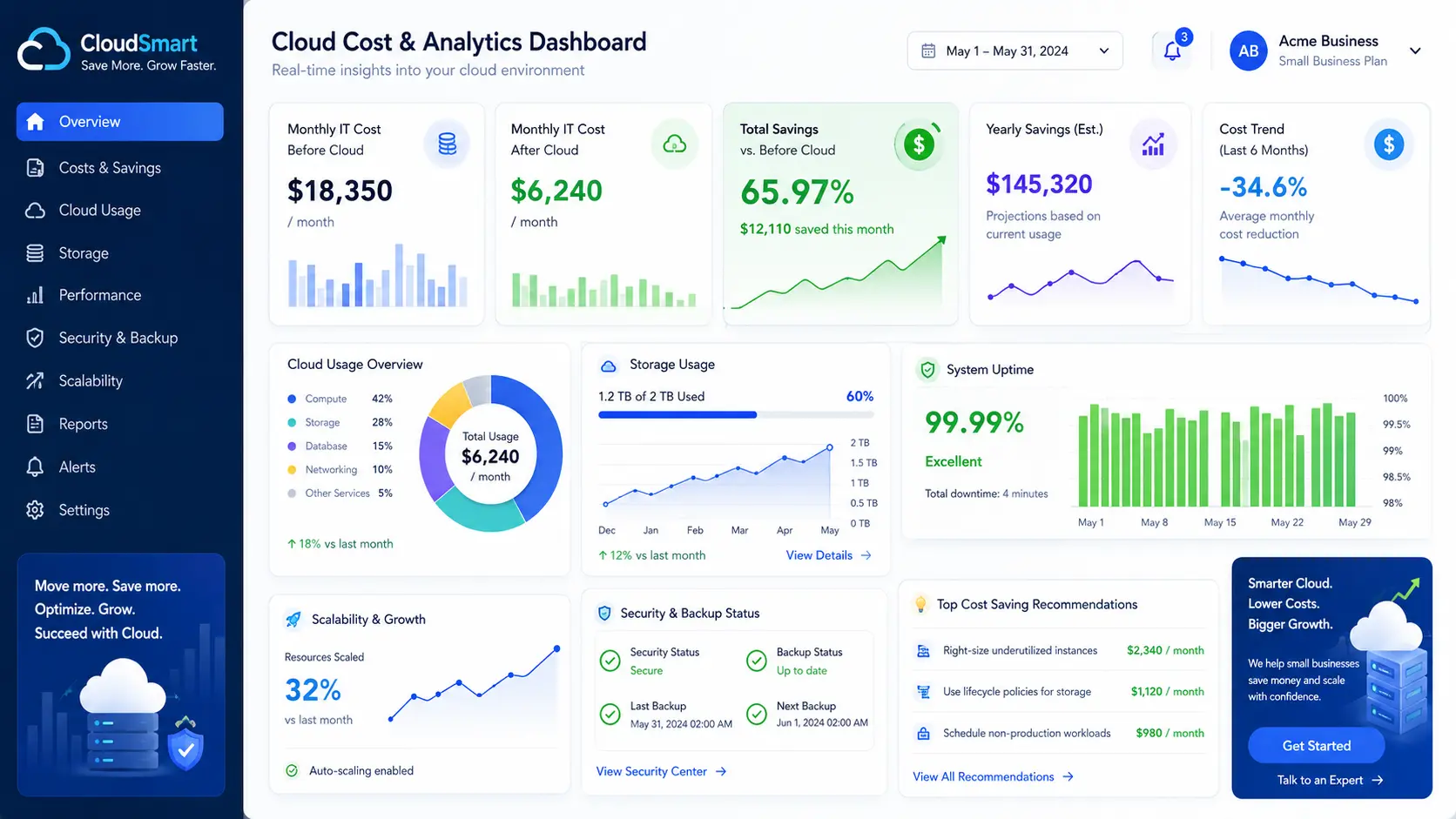
Cloud bills can grow through oversized servers, unused storage, duplicate services, excessive data transfer, and forgotten development resources. Cost optimization connects spending to actual workloads and business value.
Cloud Migration Is More Than Moving Files
A successful small-business cloud migration includes discovery, dependency mapping, backups, testing, security, user communication, and rollback planning. The migration is also an opportunity to remove outdated data, simplify processes, and fix weaknesses that would otherwise follow the business into the new environment.
Some systems can move with minimal change. Others should be modernized, replaced with software as a service, or kept in a private environment. The right answer may be cloud-first, hybrid, or phased rather than an all-at-once move.
Choosing Between AWS, Azure, and Other Platforms
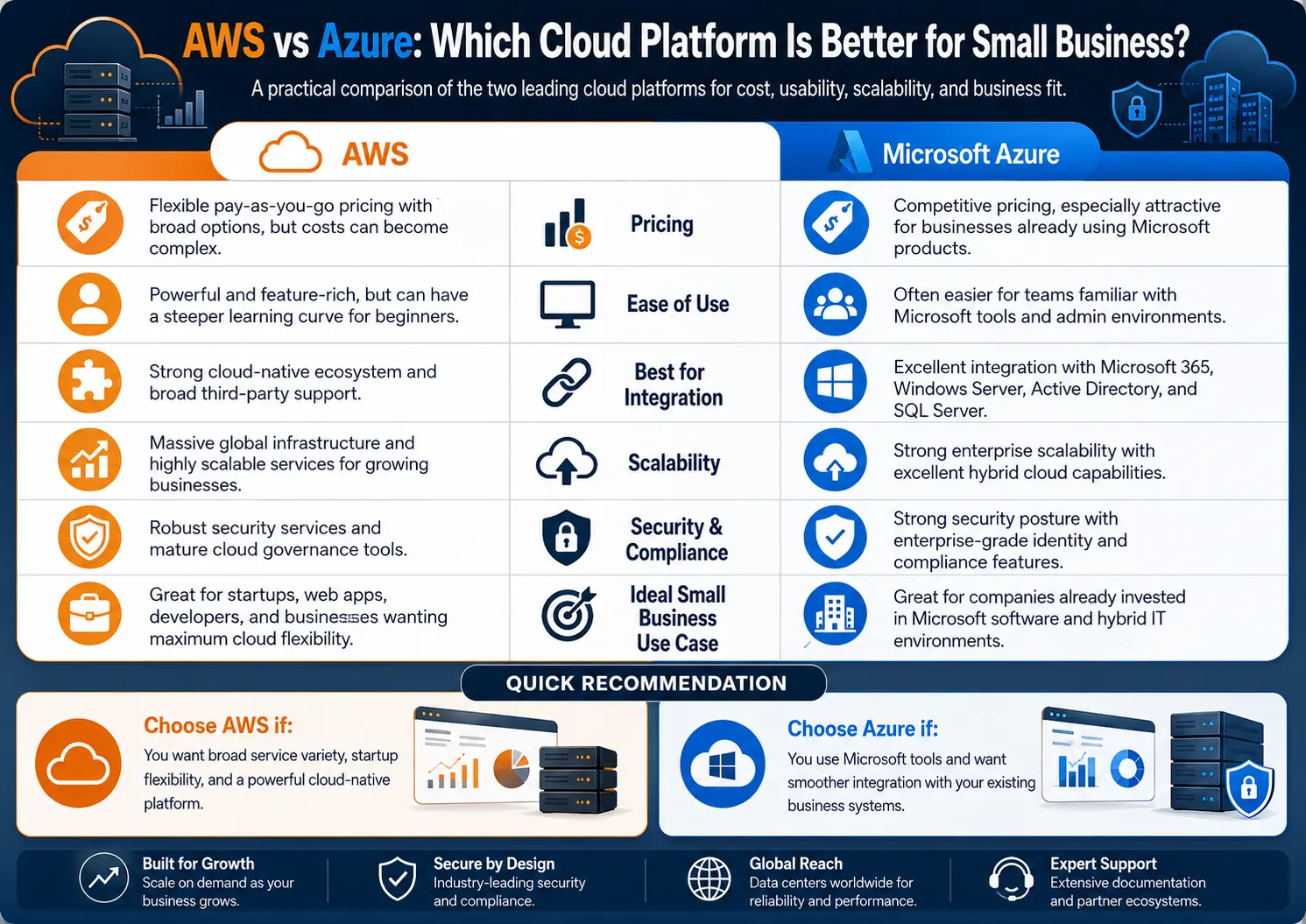
Platform selection should follow the workload. AWS offers a broad cloud service portfolio and is common for web applications, infrastructure, data, and automation. Azure is often a strong fit for organizations centered on Microsoft identity, Windows workloads, and hybrid infrastructure. Google Cloud can be compelling for data, analytics, and cloud-native services. Managed hosting may be more practical for a straightforward website that does not need a large hyperscale architecture.
Cloud Technology Computing supports planning across AWS cloud services, Microsoft Azure cloud services, and hybrid approaches. The objective is to choose the smallest reliable solution that meets security, performance, and growth requirements.
Cloud Security Should Be Designed at the Beginning
Security is not an add-on after migration. It should shape identity, permissions, data storage, logging, encryption, backups, application configuration, and incident response from the start. A cloud consultant should also explain the shared-responsibility model so the business understands which controls belong to the cloud provider and which remain the customer’s responsibility.
A Practical Houston Cloud Roadmap
- Weeks 1–2: discovery. Inventory systems, owners, vendors, data, costs, pain points, and business priorities.
- Weeks 3–4: architecture and risk plan. Select target services, security controls, migration groups, and success measures.
- Pilot: move a low-risk workload, test performance and recovery, and document lessons.
- Migration waves: move related systems in controlled groups with business validation.
- Optimization: monitor cost, performance, security, and user experience after launch.
How to Choose a Houston Cloud Consulting Company
- Look for a provider that can explain technical decisions in business language.
- Ask for a written scope, architecture, migration plan, and ownership model.
- Confirm that security, backups, monitoring, and cost controls are included.
- Choose a partner that can support websites, databases, applications, and automation—not only infrastructure.
- Avoid proposals that recommend many services before the consultant understands your current environment.
Frequently Asked Questions
Does a Houston company need a local cloud consultant?
Many cloud tasks can be completed remotely, but a Houston-based partner can be useful for local business context, on-site discovery when needed, and long-term relationship building.
Can a small business start with one cloud project?
Yes. A business can begin with managed hosting, secure backups, a website migration, a database, or one workflow. A phased approach lowers risk and builds internal confidence.
How long does cloud migration take?
The timeline depends on system complexity, data size, integrations, testing, compliance, and business availability. A simple website may move quickly, while connected applications and databases require a longer staged plan.
Plan Your Houston Cloud Roadmap
Cloud Technology Computing helps Houston businesses evaluate cloud options, migrate carefully, strengthen security, and manage infrastructure without unnecessary complexity.
Book a free consultation with Cloud Technology Computing to discuss your goals, current systems, and next best step.
0 Comments