 For Client Support:


 Blog Details
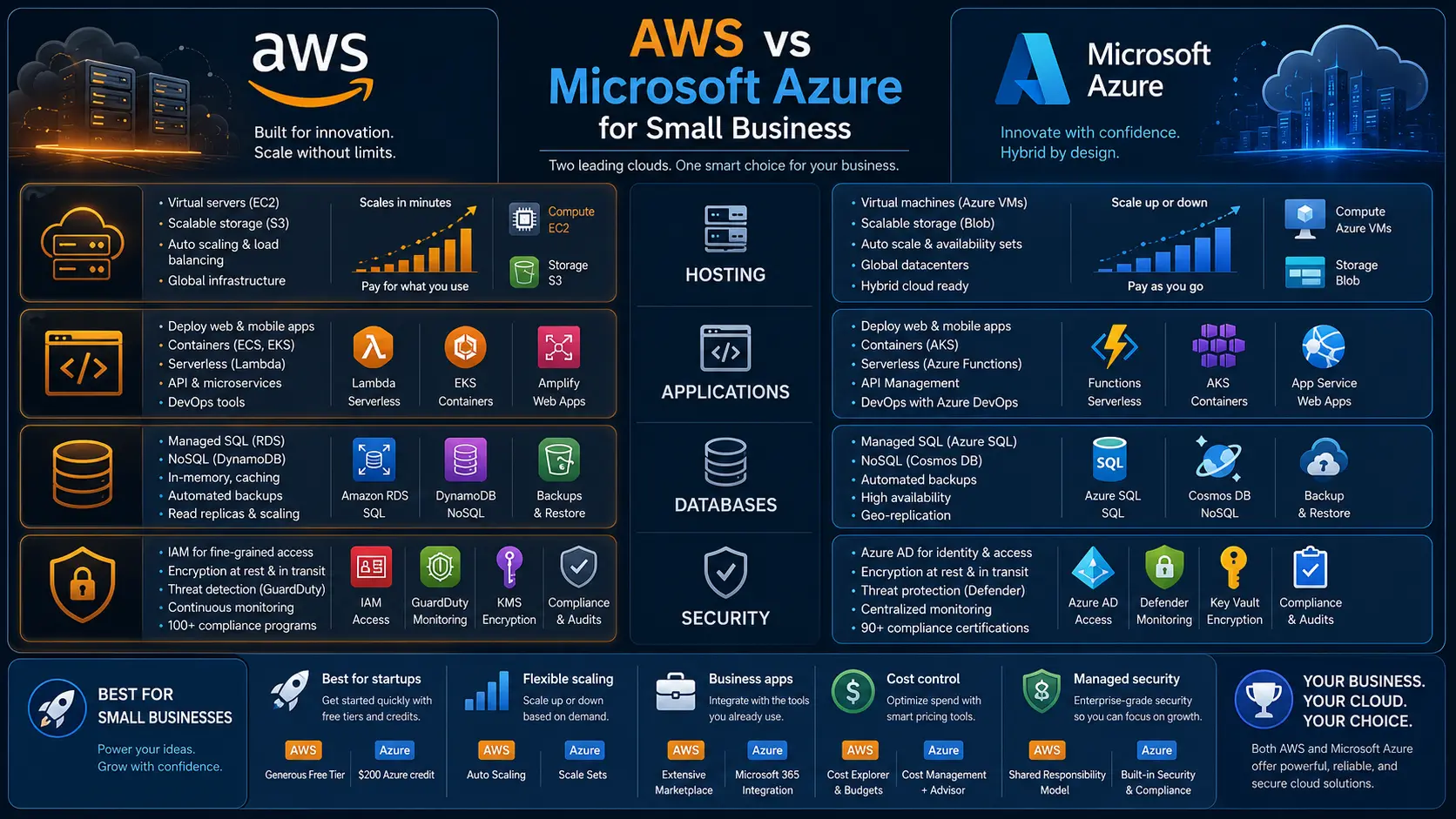

AWS vs Azure for small business is not a contest with one universal winner. Amazon Web Services and Microsoft Azure can both host websites, applications, databases, storage, backups, analytics, and automation. The better choice depends on the company’s existing tools, staff skills, workload design, security requirements, and budget controls.
A small business should avoid choosing a platform only because it has the largest service catalog or the strongest brand recognition. Start with the workload and the operating model. A simple website, a Microsoft-centered office, a custom application, and a data analytics project may each lead to a different answer.
AWS in Plain Language
AWS is Amazon’s cloud platform. It offers a broad set of infrastructure and managed services for compute, storage, networking, databases, serverless applications, security, data, artificial intelligence, and development operations.
AWS is often a strong fit when a business needs flexible infrastructure, a large ecosystem, many architecture options, or cloud-native application services. Learn more about planning AWS cloud services for a business workload.
Azure in Plain Language
Microsoft Azure is Microsoft’s cloud platform. It provides infrastructure, databases, application hosting, identity, security, analytics, artificial intelligence, and hybrid-cloud services.
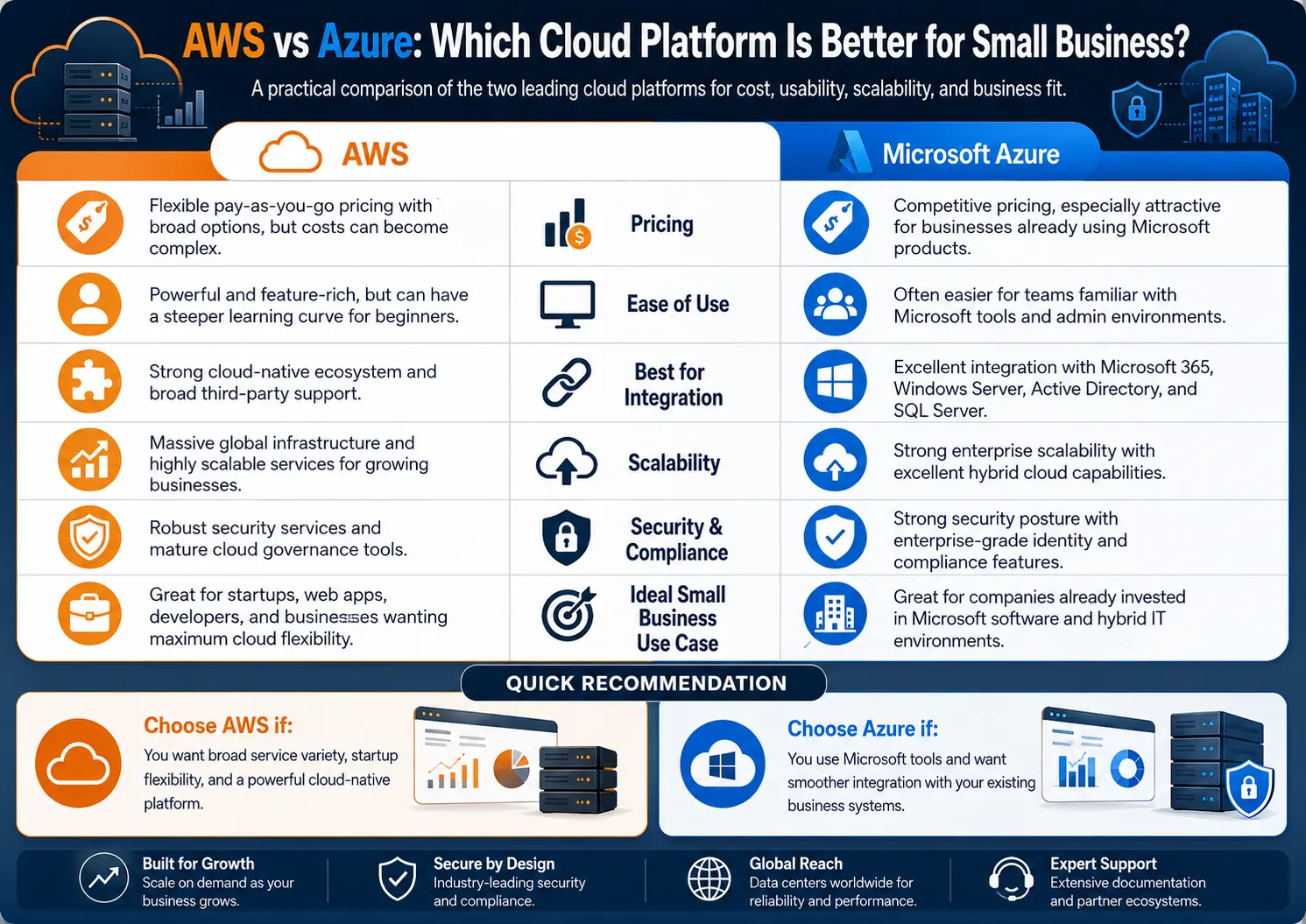
Azure is often attractive to businesses that already depend on Microsoft 365, Windows Server, SQL Server, Active Directory, .NET applications, or Microsoft-centered administration. Explore Microsoft Azure cloud services and hybrid planning.
AWS vs Azure: Key Decision Areas
Existing technology
A Microsoft-heavy company may find Azure identity, Windows, SQL Server, and hybrid integrations familiar. A company already running AWS workloads or using tools built around the AWS ecosystem may benefit from staying consistent. Existing contracts and staff experience also matter.
Website and application hosting
Both platforms can host static sites, PHP applications, APIs, containers, serverless functions, and complex multi-tier systems. For a straightforward marketing website, a managed hosting platform may be simpler and less expensive to operate. Hyperscale cloud becomes more valuable when the application needs advanced networking, automation, integrations, or variable capacity.
Identity and user management
Azure can be a natural extension for organizations already using Microsoft identity. AWS has mature identity and access management for cloud resources and applications. In either platform, administrators must design roles carefully, enable multi-factor authentication, and avoid broad permissions.
Databases and data services
Both platforms support relational, NoSQL, analytics, caching, and managed database options. Choose based on the application’s database engine, scaling needs, availability requirements, backup strategy, and the team’s ability to operate the service.
Hybrid cloud
Azure is frequently considered for Microsoft-centered hybrid environments. AWS also supports hybrid and edge designs. The best enterprise hybrid cloud plan depends on which systems must remain private, how identity is managed, and what latency or compliance constraints exist.
Security
Both platforms provide strong security capabilities. The business is still responsible for account protection, permissions, workload configuration, data handling, application security, logging, and response. Security outcomes depend more on disciplined implementation than the platform logo.
Cost management
Cloud cost depends on architecture and usage. Compute size, storage type, backups, data transfer, logging, support plans, and managed services all contribute. Compare the complete operating design, not a single server price.
When AWS May Be the Better Fit
- The team already has AWS skills, tooling, or production workloads.
- The application needs a broad range of cloud-native services and architecture choices.
- The company is building custom web applications, APIs, data pipelines, or serverless workflows around AWS.
- Existing partners, software, or deployment processes are designed for AWS.
When Azure May Be the Better Fit
- The organization is strongly centered on Microsoft 365, Windows, SQL Server, Active Directory, or .NET.
- Hybrid identity and Microsoft infrastructure are major requirements.
- The internal team is more comfortable with Microsoft administration and licensing.
- Business applications integrate closely with the Microsoft ecosystem.
When Managed Hosting May Be Better Than Either
A small business does not need AWS or Azure for every website. If the primary need is dependable hosting for a marketing site, blog, or modest PHP/MySQL application, a quality managed host can reduce administrative work. The architecture should match the workload rather than forcing a simple site into a complex cloud environment.
Can a Small Business Use Both AWS and Azure?
Yes, but multi-cloud adds identity, networking, monitoring, security, billing, and skills complexity. Use multiple platforms when there is a clear business reason, such as a required application, customer contract, acquisition, or specialized service. Do not adopt multi-cloud only to avoid making a decision.
A Simple Selection Process
- List the applications, data, users, integrations, performance needs, and recovery requirements.
- Identify existing Microsoft, AWS, hosting, and software dependencies.
- Estimate the full monthly design, including backups, monitoring, support, and data transfer.
- Build a small pilot and test deployment, security, recovery, and administration.
- Choose the platform the team can operate reliably—not only the one that looks best in a feature comparison.
Frequently Asked Questions
Is AWS cheaper than Azure?
Neither platform is always cheaper. Pricing depends on the exact service, region, usage pattern, discounts, storage, data transfer, and architecture. A cost comparison should model the complete workload.
Which cloud is easier for beginners?
Ease depends on background. Microsoft administrators may find Azure more familiar, while developers with AWS training may prefer AWS. Managed services can reduce operations but still require security and cost knowledge.
Can Cloud Technology Computing help with both?
Yes. Cloud Technology Computing can assess the workload, compare platforms, create a migration plan, and help design secure, right-sized infrastructure.
Choose the Right Cloud Platform
A platform comparison is most valuable when it is based on your real website, applications, users, data, security requirements, and budget.
Book a free consultation with Cloud Technology Computing to discuss your goals, current systems, and next best step.
0 Comments